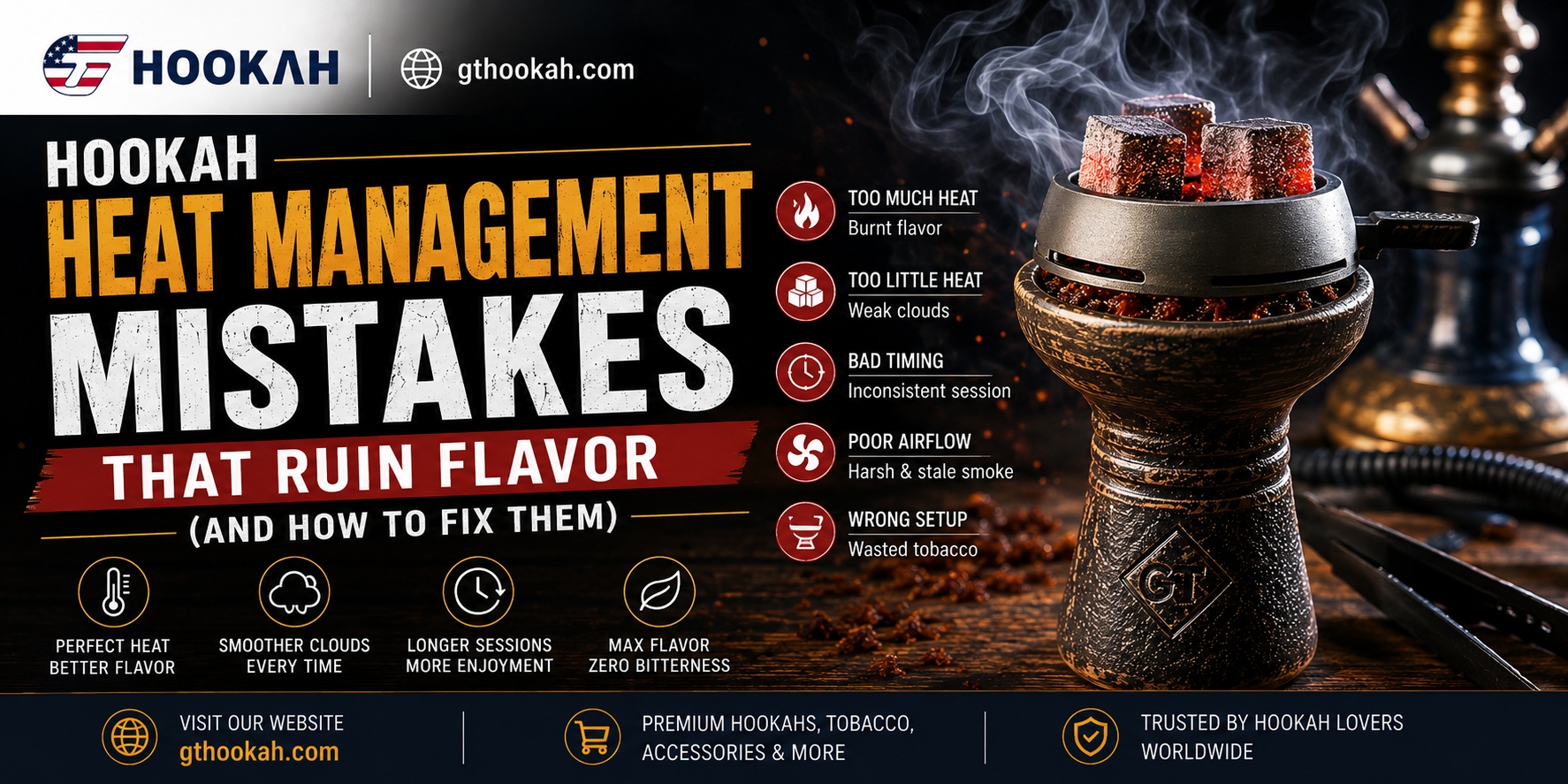
A good hookah session is not just about choosing quality tobacco or a premium hookah. Heat management plays one of the biggest roles in determining how the tobacco tastes, how smoothly the session develops, and how long the bowl remains enjoyable.
Too much heat can turn a flavorful bowl harsh and burnt. Too little heat can leave the tobacco underheated, producing weak flavor and thin smoke. The challenge is finding the right balance and maintaining it throughout the session.
Many heat-related problems come from simple mistakes: using too much charcoal, placing coals incorrectly, overheating the bowl during the first few minutes, or failing to adjust heat as the session progresses.
This guide explains the most common hookah heat-management mistakes, why they affect flavor, and how to correct them.
What Is the Biggest Hookah Heat Management Mistake?
The most common mistake is using more heat than the tobacco and bowl can handle. Excessive charcoal or poor charcoal placement can overheat the tobacco, causing harsh smoke and burnt flavor. Start with moderate heat, allow the bowl to warm gradually, and adjust charcoal placement throughout the session rather than applying maximum heat from the start.
Why Heat Management Matters for Hookah Flavor
Heat activates the flavor and vapor-producing ingredients in hookah tobacco. The objective is to heat the tobacco enough to produce a satisfying session without overheating it.
When the temperature is controlled properly, the flavor can develop gradually. When the bowl becomes excessively hot, the tobacco can become harsh, and its flavor profile may change quickly.
Heat management also affects:
- Flavor intensity
- Smoke production
- Session consistency
- Tobacco longevity
- Harshness
- Charcoal consumption
- Overall smoking experience
This is why heat management should be treated as an active part of preparing and smoking a hookah rather than something you set once and forget.
1. Using Too Many Charcoals
One of the easiest ways to overheat a hookah bowl is to start with too much charcoal.
More charcoal does not automatically mean thicker clouds or stronger flavor. It simply increases the amount of heat being transferred to the bowl.
If the tobacco is already heat-sensitive, excessive charcoal can cause harshness very quickly.
How to Fix It
Start with a moderate amount of charcoal appropriate for your bowl and heat-management setup. If the bowl needs more heat later, increase it gradually instead of starting at maximum heat.
2. Placing Charcoal Directly in the Center
Charcoal placement can significantly affect how heat spreads across the bowl.
Placing all the charcoal in one central area can concentrate heat instead of distributing it evenly. Depending on the bowl and heat-management device, this may cause one section of the tobacco to become much hotter than another.
How to Fix It
Position charcoal according to the design of your bowl and heat-management device. Moving charcoal toward the edges can help reduce direct heat on the tobacco when the bowl becomes too hot.
The goal is controlled, even heating rather than concentrating all the heat in one location.
3. Overheating the Bowl Before the First Puff
Preheating is useful, but there is a difference between warming the bowl and overheating it.
Leaving charcoal on the bowl for too long before starting the session can push the tobacco beyond its ideal heat range before you even begin smoking.
How to Fix It
Give the bowl enough time to warm up, but pay attention to how quickly heat builds. If your first few pulls are already harsh, reduce the initial heat and shorten the preheating period.
4. Ignoring the Tobacco Type
Different hookah tobaccos can respond differently to heat.
A packing technique and heat level that works well for one tobacco may not work equally well for another. Tobacco cut, moisture, leaf type, and blend characteristics all influence how it responds.
For example, a tobacco packed densely may retain heat differently from a loose, fluffy pack.
This is why heat management should always be considered together with your bowl preparation method.
5. Keeping Charcoal in the Same Position for Too Long
Charcoal placement is not necessarily permanent throughout the session.
As the bowl heats up, the tobacco may become increasingly sensitive to additional heat. Keeping charcoal in exactly the same position for the entire session can eventually lead to overheating.
How to Fix It
Move the charcoal periodically when necessary. If the flavor starts becoming harsh, reduce the heat before assuming the tobacco itself is the problem.
Small adjustments are usually better than making a dramatic change.
6. Using Charcoal That Is Not Fully Lit
Partially lit charcoal can create inconsistent heat and may affect the overall smoking experience.
When charcoal is not properly heated, the bowl may struggle to reach a consistent temperature. Users may then compensate by adding more charcoal, which can eventually cause excessive heat once the original pieces become fully lit.
How to Fix It
Make sure your charcoal is properly prepared before using it. Consistent charcoal quality and preparation make heat management much easier.
7. Constantly Adding More Charcoal
Another common mistake is reacting to weak smoke by immediately adding more charcoal.
Thin smoke does not always mean insufficient heat. The issue could be airflow, tobacco packing, bowl preparation, or another part of the setup.
Adding more charcoal without identifying the actual problem can turn a mild session into an overheated one.
How to Fix It
Before adding heat, check the basics:
- Is the bowl packed correctly?
- Is airflow unrestricted?
- Is the tobacco evenly distributed?
- Is the charcoal properly lit?
- Has the bowl had enough time to warm up?
Fix the underlying issue before increasing heat.
8. Using the Same Heat Strategy for Every Bowl
Different bowl shapes and materials can distribute heat differently.
A shallow bowl may respond differently from a deeper bowl. A phunnel bowl may also behave differently from a traditional-style bowl.
Your heat-management device adds another variable.
Therefore, copying a charcoal setup from another bowl does not guarantee the same result.
If you’re still building your setup, avoiding basic equipment-selection mistakes is important too. Understanding beginner hookah buying mistakes can help you choose equipment that works together rather than treating every component separately.
9. Overheating the Tobacco to Get Thicker Clouds
Cloud size is often associated with a strong hookah session, but chasing maximum smoke can result in excessive heat.
A bowl that produces large clouds for a short period before becoming harsh is not necessarily performing better than one that produces consistent smoke and flavor for a longer session.
How to Fix It
Prioritize balanced flavor and smoothness rather than maximum cloud production. Increase heat gradually and stop increasing it once the tobacco is performing well.
10. Failing to React When Flavor Changes
Your hookah gives you useful feedback during a session.
If the flavor suddenly becomes harsh, smoky, bitter, or noticeably different, heat may be the problem.
Continuing to apply the same amount of heat can make the issue worse.
How to Fix It
When the flavor changes suddenly, reduce heat first. Move charcoal toward the edge, remove a piece if necessary, and allow the bowl to cool slightly before reassessing the session.
For more general preparation and smoking issues, you can also review these common hookah smoking mistakes and compare them with your current setup.
How to Choose the Right Heat Level
There is no single charcoal arrangement that works for every hookah bowl.
Instead, consider these factors:
Bowl Size
A larger bowl may require a different heat approach from a small bowl.
Tobacco Type
Different tobacco blends can have different heat responses.
Packing Density
A fluffy pack generally responds differently from a dense pack.
Heat-Management Device
A heat-management device changes how heat reaches the tobacco and can require a different charcoal strategy from foil.
Session Stage
The bowl’s heat requirements can change as the session progresses. The heat level that works during the beginning may not be ideal later.
Signs Your Hookah Is Too Hot
Watch for these warning signs:
- Harsh smoke
- Burnt or bitter flavor
- Sudden loss of flavor
- Throat irritation
- Flavor becoming overpowering
- Tobacco heating too quickly
- Smoke becoming unpleasant despite good airflow
If several of these occur together, reduce the heat before changing the tobacco or completely rebuilding the bowl.
Signs Your Hookah Needs More Heat
On the other hand, insufficient heat may produce:
- Weak flavor
- Very light smoke
- Slow flavor development
- A cool or underheated bowl
- Little response despite good airflow
If the setup is otherwise working correctly, a small increase in heat may help.
Avoid making large changes at once. Heat management is easier when you adjust one variable at a time.
How to Improve Hookah Heat Management
A few simple habits can make sessions much more consistent.
First, use properly prepared charcoal and give the bowl enough time to warm up. Avoid starting with excessive heat simply because you want immediate smoke.
Second, pay attention to charcoal position. Moving charcoal toward the outside of the bowl can be useful when heat becomes excessive.
Third, monitor flavor rather than relying only on smoke density. Flavor changes can tell you that the tobacco is receiving too much heat before the session becomes completely harsh.
Finally, keep your setup consistent when testing different tobaccos. If you change the bowl, tobacco, pack, charcoal, and heat-management device at the same time, it becomes difficult to determine what actually improved or damaged the session.
Heat Management for Different Hookah Flavors
Flavor choice can also influence how you approach a session. Some flavor profiles may seem more noticeable under moderate heat, while others can become unpleasant when overheated.
If you are experimenting with popular flavor combinations, comparing trending hookah flavors in the USA can give you ideas for testing different tobacco profiles.
For specific Adalya combinations, you can also explore Adalya flavors to try with a Cyril Bohemian when planning a session around that setup.
Common Heat Management Mistakes at Hookah Shops
Heat control becomes even more important in a commercial environment because lounges and hookah shops may prepare many bowls throughout the day.
Inconsistent charcoal preparation, poor bowl management, and rushed setups can affect the customer experience.
For businesses, reviewing common mistakes new hookah shops make can help identify operational issues that go beyond individual bowl preparation.
Hookah Heat Management Best Practices
For a more consistent session, follow these basic principles:
- Start with moderate heat.
- Use properly prepared charcoal.
- Avoid automatically using more charcoal for thicker smoke.
- Distribute heat rather than concentrating it in one area.
- Monitor the flavor throughout the session.
- Move or remove charcoal when the bowl becomes too hot.
- Consider tobacco type and packing density.
- Adjust your approach for different bowl designs.
- Change one variable at a time when troubleshooting.
- Prioritize flavor and smoothness over maximum smoke production.
FAQs About Hookah Heat Management
1. Why does my hookah taste burnt?
A burnt taste is commonly caused by excessive heat, but overfilling the bowl, unsuitable packing density, or tobacco sitting too close to the heat source can also contribute. Reduce the heat first and reassess the setup.
2. How do I control heat in a hookah?
Start with moderate heat, allow the bowl to warm gradually, and adjust charcoal placement throughout the session. Avoid making large heat changes unless the bowl is clearly overheating.
3. Should hookah coals be placed in the center or around the edge?
It depends on the bowl and heat-management setup. Moving charcoal toward the edges can help reduce direct heat when the bowl becomes too hot, while placement closer to the center may provide more direct heating.
4. How many coals should I use for a hookah?
There is no universal number. The appropriate amount depends on the bowl size, tobacco, charcoal type, heat-management device, and desired heat level. Start conservatively and increase heat only when needed.
5. Why does my hookah become harsh after a few minutes?
The bowl may be accumulating too much heat. Charcoal that remains in one position for too long or excessive heat from the beginning can cause the tobacco to become harsh. Reduce or reposition the charcoal and allow the bowl to stabilize.
6. How can I get better hookah flavor without burning the tobacco?
Focus on balanced heat rather than maximum heat. Use an appropriate tobacco pack, properly prepared charcoal, and gradual heating. Monitor flavor during the session and reduce heat as soon as the tobacco begins tasting harsh.
Conclusion
Good hookah heat management is about balance. Too little heat can produce weak flavor and smoke, while too much heat can quickly ruin an otherwise well-prepared bowl.
The best approach is to start gradually, understand how your tobacco and bowl respond, and make small adjustments throughout the session. Charcoal placement, tobacco packing, bowl design, and heat-management equipment all work together, so there is rarely a single solution for every setup.
At GT Hookah, understanding how different hookah components work together can help users make better decisions about bowls, tobacco, charcoal, and accessories. Instead of chasing maximum heat, focus on controlled heating that keeps the flavor consistent from the beginning of the session to the end.